


The Extinction Ratio Trap: How to Spec Polarization-Maintaining (PM) Patch Cords Without Ruining Your Signal
Apr 01, 2026
When a coherent optical transmission system or a fiber optic gyroscope starts returning erratic data, engineers often blame the laser or the modulator. Nine times out of ten, the actual culprit is a cheap Polarization-Maintaining (PM) patch cord that just lost its Extinction Ratio.
Stop treating PM fiber like standard Single-Mode Fiber (SMF). Standard OS2 fiber only has one job: guide the light. A Polarization-Maintaining patch cord has two jobs: guide the light, and forcefully lock its polarization state in a straight line. If the manufacturer misses the alignment angle by even a few degrees during termination, the polarization state collapses, causing "cross-coupling" and destroying your signal integrity.
If you are sourcing PM cables for LiDAR, DWDM coherent systems, or medical sensors, here is the engineering reality of what you are actually buying, and the specs you must verify before installation.
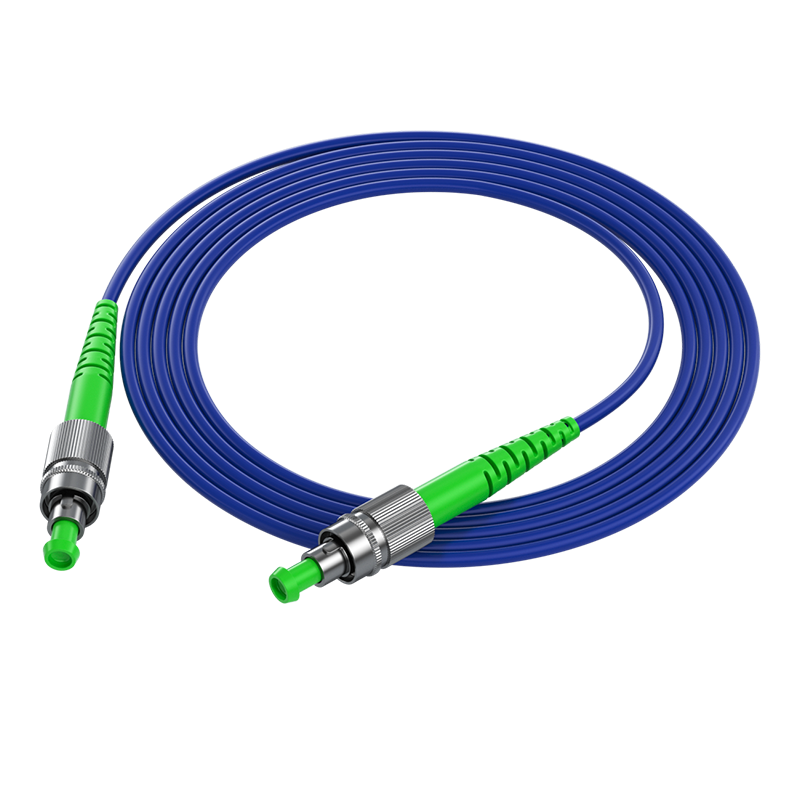
1. The Anatomy of PM Fiber: Why "Panda" is the Standard
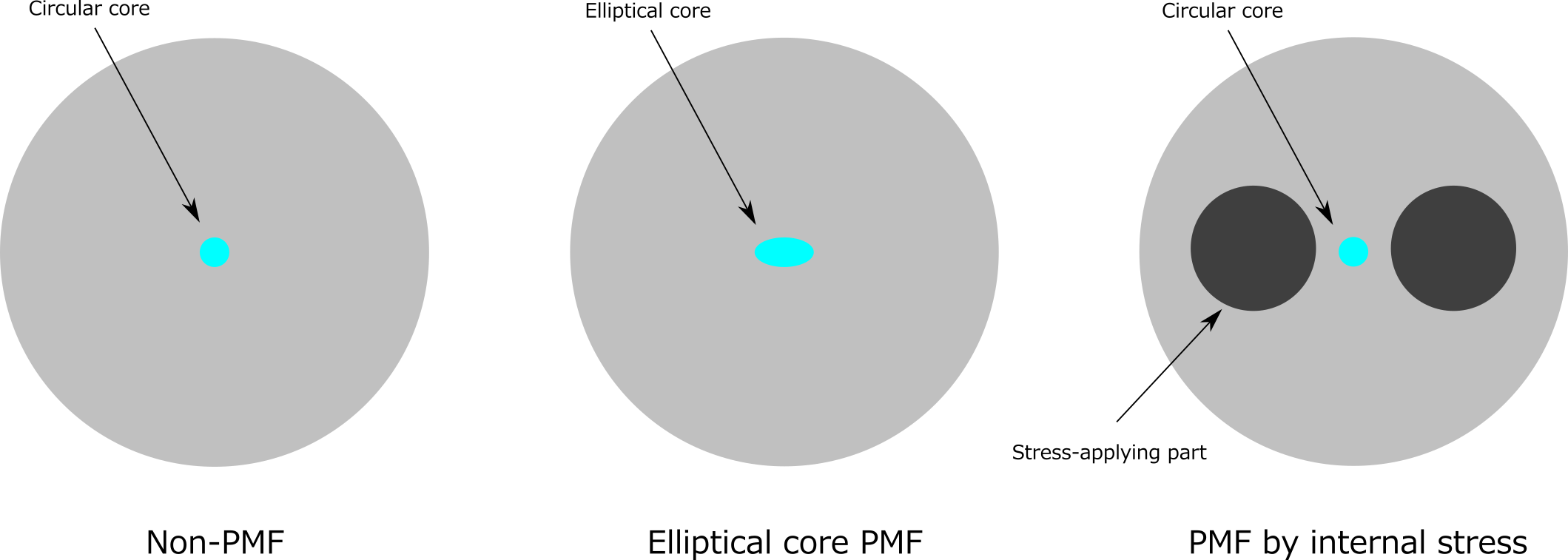
If you slice a standard SMF cable open, the core is a perfect, symmetrical circle. If you slice a PM fiber open under a microscope, you will see two dark circles flanking the core. These are the Stress-Applying Parts (SAPs).
These SAPs create intentional, controlled mechanical stress inside the glass, forcing the light to travel along a specific path (the Slow Axis) and preventing it from drifting. While there are different designs (Bow-tie, Elliptical Cladding), the industry standard for telecommunications and precision sensing is Panda Fiber.
Why Panda? Because the circular stress rods provide highly symmetrical birefringence. It integrates seamlessly with standard telecom transceivers and offers the lowest insertion loss when spliced to conventional single-mode fibers. If your BOM doesn't explicitly specify "Panda PM Fiber," you need to update it.
2. The Alignment Nightmare: Slow Axis vs. Fast Axis
Here is where cheap manufacturers ruin the cable. Light in a PM fiber travels horizontally (the Slow Axis) or vertically (the Fast Axis). To maintain the polarization state, the laser light must be injected perfectly parallel to the Slow Axis.
How does the technician in the field know where the Slow Axis is? The Connector Key. When the factory terminates the PM patch cord, they must use a high-powered microscope to align the Panda stress rods perfectly with the physical key on the FC, SC, or LC connector.
The Tolerance: The industry standard for alignment accuracy is ±3 degrees.
The Failure: If the factory's alignment is off by 5 degrees, a significant portion of the light will "jump" into the Fast Axis. Your polarized signal becomes scrambled, rendering phase-sensitive equipment useless.
You are not just buying a piece of glass; you are buying microscopic angular precision.
3. The Extinction Ratio (ER) Metric: Demand the Test Report
The health of a Polarization-Maintaining patch cord is measured by one critical metric: the Extinction Ratio (ER). ER measures how well the fiber isolates the light in the correct axis versus how much light "leaked" into the wrong axis. It is measured in decibels (dB).
< 15 dB: Unacceptable for precision equipment. You are losing phase control.
20 dB: The standard baseline for commercial telecom applications.
> 25 dB to 30 dB: High-precision grade. Mandatory for interferometers, fiber optic gyroscopes, and quantum research.
The Golden Rule for Buyers: Never accept a batch of PM patch cords without an individualized ER test report. If the supplier cannot provide interferometry and ER testing data for each specific serial number, they are guessing. And in coherent optics, guessing costs thousands of dollars.
4. The Installation Warning: Stress Kills Polarization
You bought a high-ER, perfectly aligned PM patch cord. But your system is still failing. Why? Because your installation team treated it like regular fiber.
PM fiber is hypersensitive to external physical stress. If you pull a zip-tie too tight around a PM cable jacket, or bend it past its minimum bend radius, you alter the internal stress of the glass. This external stress overrides the Panda SAPs, causing immediate cross-coupling. The Extinction Ratio will plummet from 25dB to 10dB instantly.
Field Tip: Always use Velcro straps, maintain wide sweeping bend radii, and ensure the patch cord hangs loosely in the rack without tension.
Conclusion: Sourcing Precision, Not Plastic
When you specify a Polarization-Maintaining patch cord, you are sourcing a precision optical waveguide. A minor defect in the polishing angle or a slight rotation in the connector ferrule turns the cable into a liability.
Don't compromise your optical budget on poorly aligned cables. Based in Wuhan Optics Valley-the heart of global optical manufacturing-since 2010, the wolonfiber engineering team understands the strict tolerances required for coherent transmission. Operating out of three specialized factories with a dedicated workforce of 400-500 employees, every PM patch cord we manufacture undergoes rigorous 3D interferometry and Extinction Ratio testing before it ships.
Whether you need narrow-linewidth laser delivery or DWDM coherent patching, our cables are trusted by engineers in over 80 countries. Contact us today with your ER and connector key requirements (Narrow Key / Wide Key), and let's secure your polarization state.


